

身体全体のミトコンドリアの糖のエネルギー代謝こそ、生命活動を支える根本であり、最重要であるということを述べてきました。逆に言えば、そのミトコンドリアの機能が障害されるようなことがあると、身体の機能は衰えていくということになります。
それでは、ミトコンドリアはどのような要因で障害されるのでしょうか??
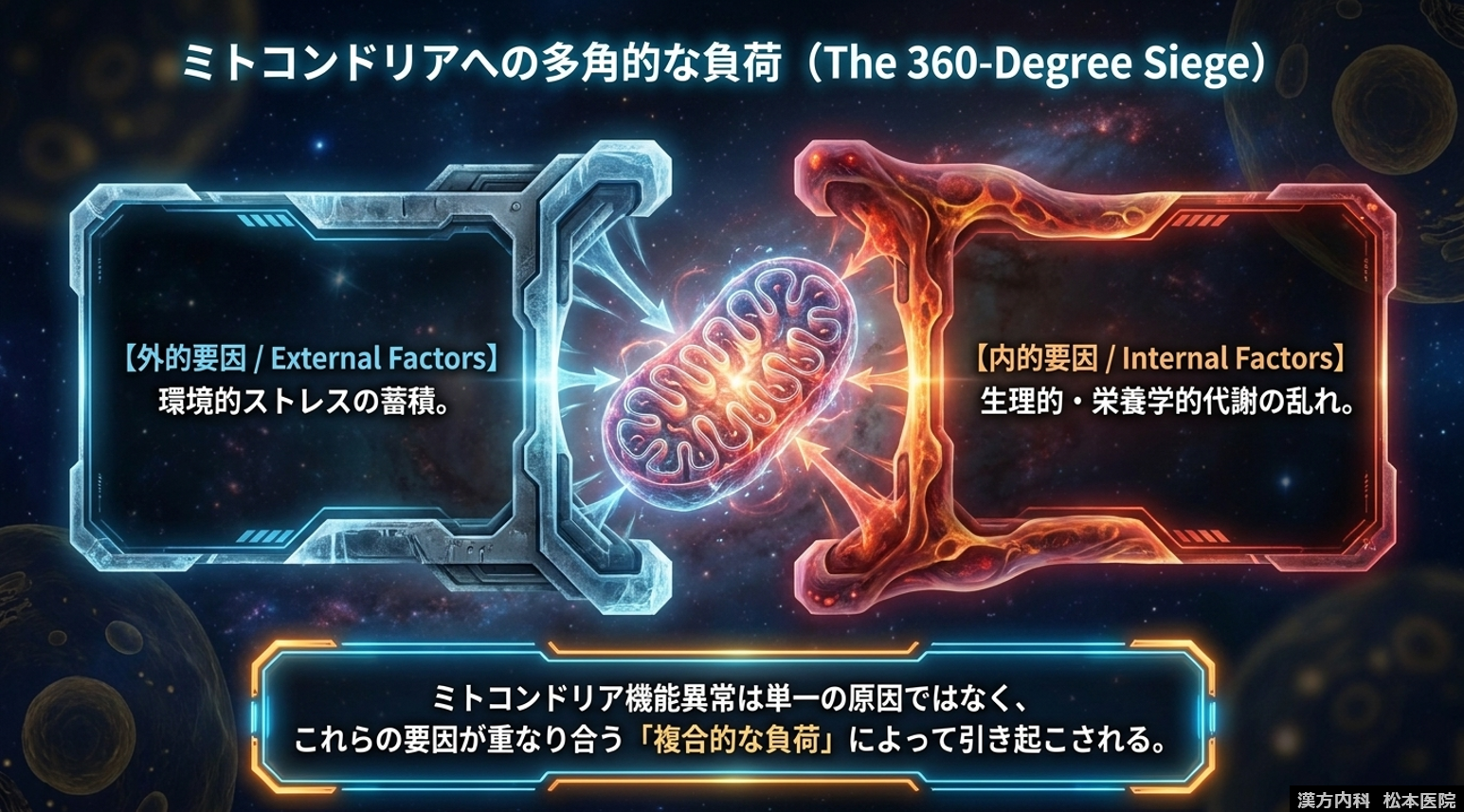
ミトコンドリアの機能異常は、単一の原因で生じるものではなく、複数の要因が重なり合うことで引き起こされますが、主に「外的要因」と「内的要因」に分けられます。
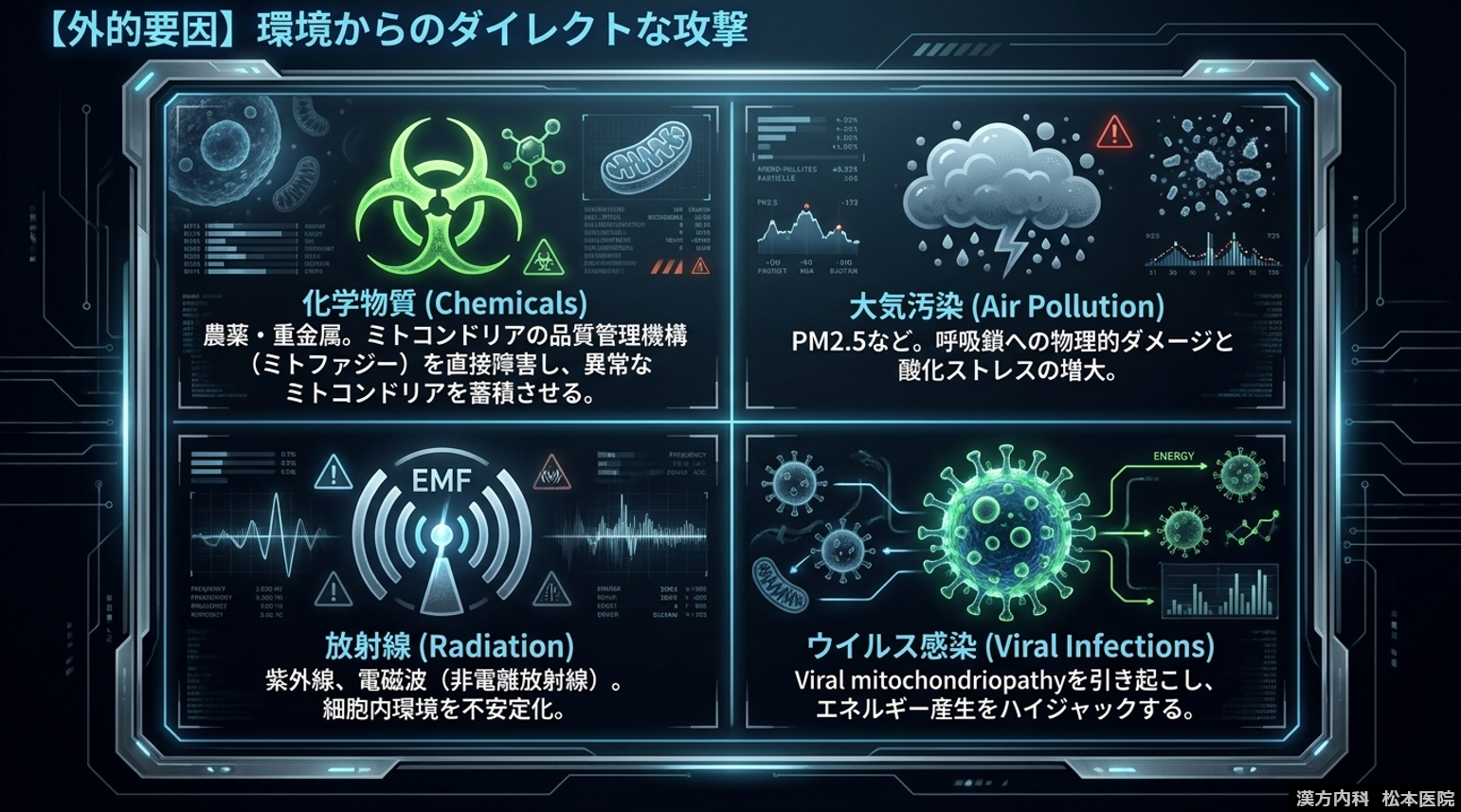
「外的要因」としては、以下のようなものがあります▽
・化学物質(農薬・重金属など)[188-192]
・大気汚染[191,193-196]
・紫外線[197-200]
・電磁波(非電離放射線)[201-204]
・ウイルス感染[205-210]
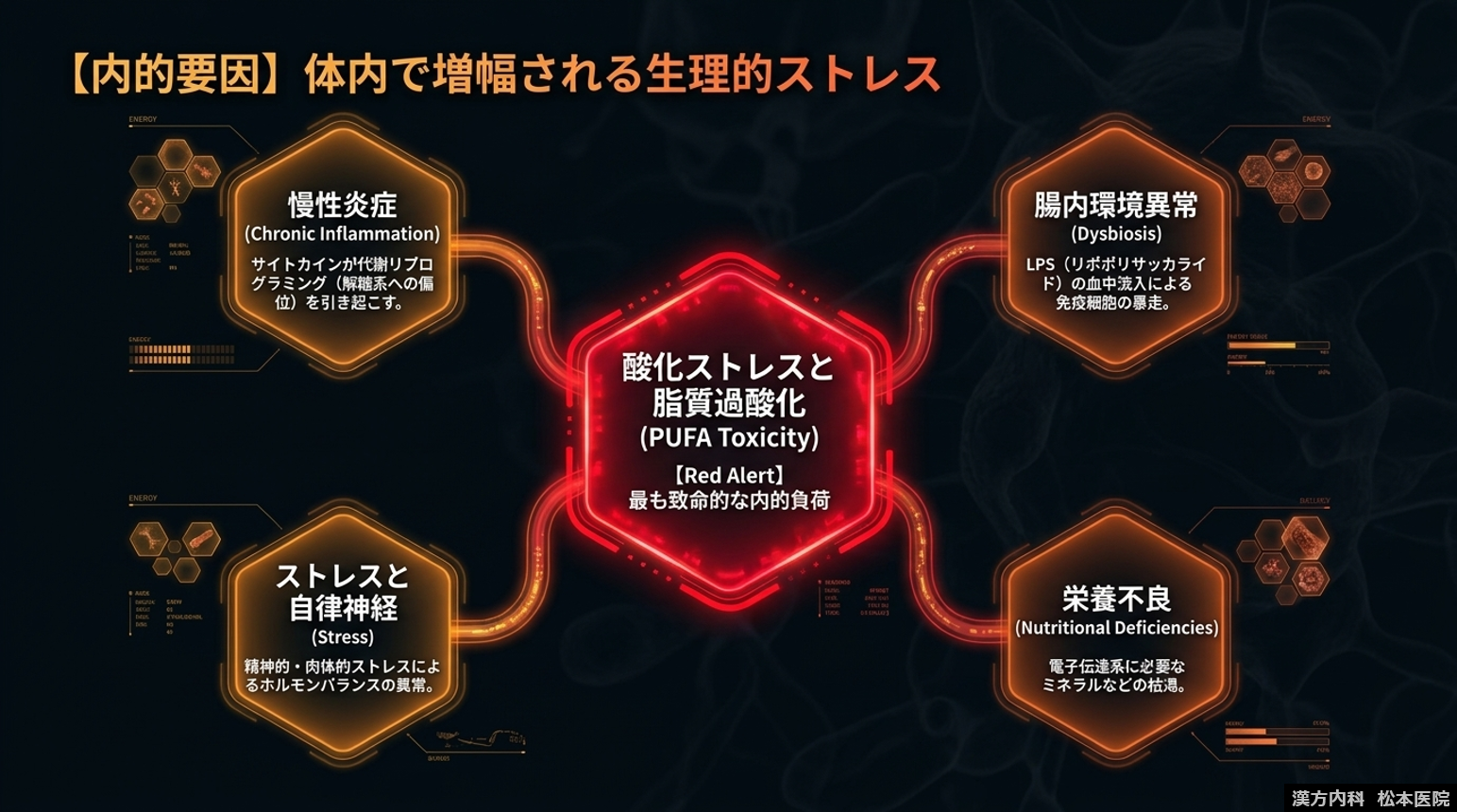
「内的要因」としては以下のようなものがあります▽
・慢性炎症[211-214]
・腸内環境異常(dysbiosisやLPSなど)[215-217]
・精神的・肉体的ストレス、自律神経/ホルモンバランス異常[218-220]
・酸化ストレス(PUFAによる脂質過酸化など)[221-225]
・栄養状態悪化(ミネラル不足など)[225-228]
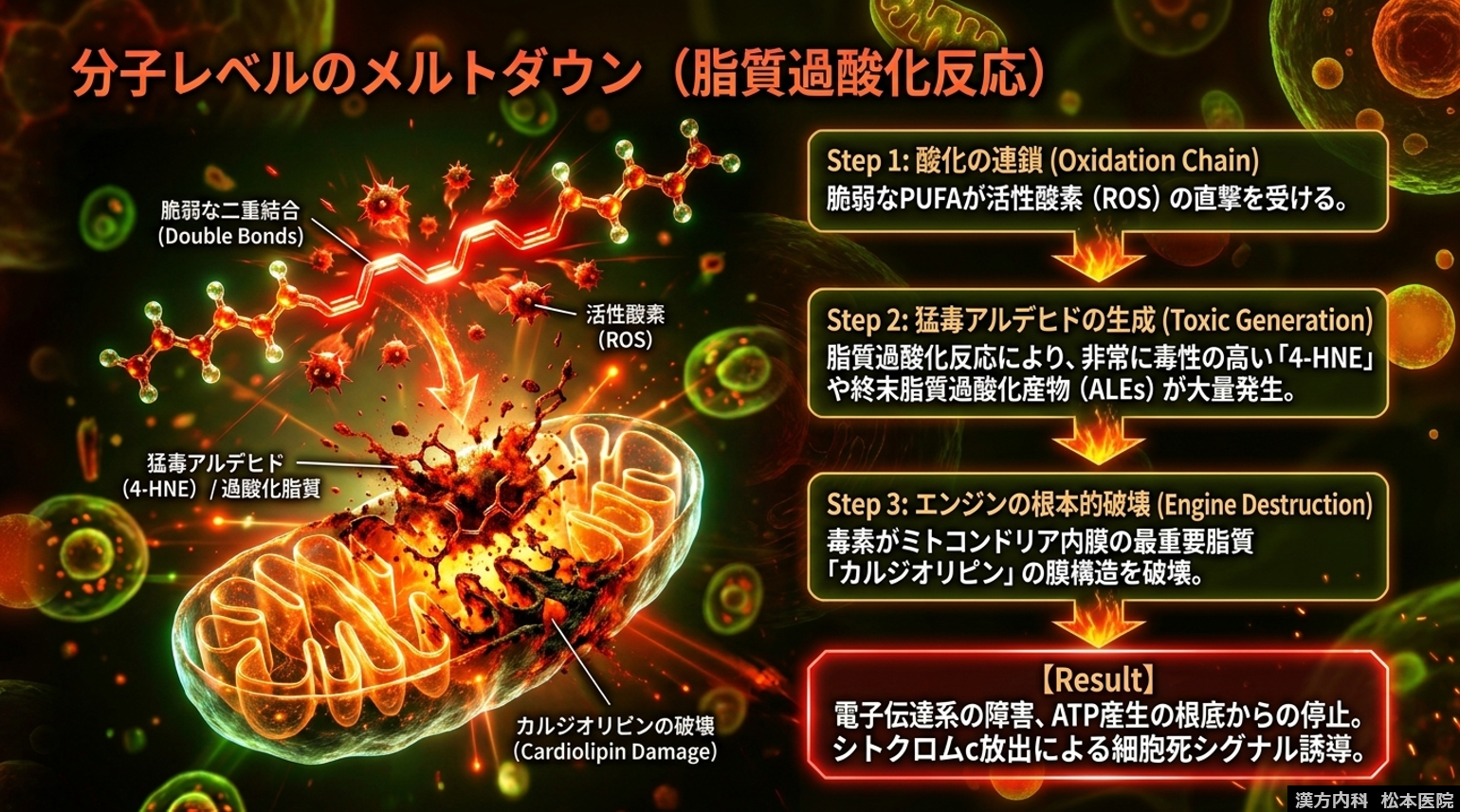
この中で当院が大きな問題だと思っているのは、多価不飽和脂肪酸(Polyunsaturated Fatty Acids:PUFA)によるミトコンドリア障害です。PUFAがもたらす害についての詳細は第四章に譲りますが、PUFAは酸化されやすく、活性酸素(ROS)によって脂質過酸化反応を起こしやすい性質があります[229-232]。その結果、反応性の高い有害なアルデヒド(4-HNEなど)が生成されると、ミトコンドリアの電子伝達系やATP合成酵素を障害します[233-235]。また、内膜の主要脂質であるカルジオリピンが過酸化されると膜構造が不安定化し、エネルギー産生効率の低下やシトクロムcの放出を招き、炎症や細胞死の引き金となります[236-238]。さらに、遊離PUFA自体も脱共役や呼吸阻害を引き起こし、ミトコンドリア機能を低下させる要因となり得ることがわかっています[239,240]。
また、慢性炎症もミトコンドリア機能に深く関与しています。炎症性サイトカインやLPS(リポポリサッカライド:腸内細菌の菌体内毒素)は、ミトコンドリアの代謝経路を変化させ、解糖系への偏位(いわゆる代謝リプログラミング=免疫代謝)を引き起こします[241-243]。この状態が持続すると、ミトコンドリアの機能は徐々に低下し、細胞はエネルギー効率の低い状態に固定され、病的な状態に陥ってしまいます。
さらに、外的要因では、環境中の化学物質や重金属、電磁波、精神的ストレスなども、ミトコンドリアに対する慢性的な負荷として働きます。これらの要因のうち、特にある種の化学物質や重金属で、ミトコンドリアの品質管理機構(ミトファジー)が障害され、損傷したミトコンドリアの蓄積を招くことが知られています[244-248]。
このように、複数の要因で引き起こされるミトコンドリア機能異常は、細胞レベルのエネルギー代謝の恒常性の破綻が全身に波及した状態であり、身体全体の状態を反映した現象といえます。そして、近年では、ミトコンドリアは単なるエネルギー産生装置ではなく、免疫応答や炎症シグナル、さらには遺伝子発現の制御にも関与する統合的な制御システムとして機能していることが明らかになってきています。このように、ミトコンドリアは外的・内的要因によって常にさまざまな「負荷」を受けているのです。
参考文献▽
[188] N. Shah, B. Saxena, R. Gupta, Mitochondria: Key Mediator for Environmental Toxicant–Induced Neurodegeneration, International Journal of Toxicology 44 (2025) 507–525. 10.1177/10915818251369414.
[189] R.E. Turkington, N.A. Hukriede, J. Ho, N. Jayasundara, A.P. Sanders, Metal mechanisms of mitochondrial toxicity: recent review of arsenic, cadmium, and lead-induced nephrotoxicity, Environ Sci Pollut Res Int 32 (2025) 14439–14451. 10.1007/s11356-025-36538-6.
[190] Q. Sun, Y. Li, L. Shi, R. Hussain, K. Mehmood, Z. Tang, H. Zhang, Heavy metals induced mitochondrial dysfunction in animals: Molecular mechanism of toxicity, Toxicology 469 (2022) 153136. https://doi.org/10.1016/j.tox.2022.153136.
[191] A. Reddam, S. McLarnan, A. Kupsco, Environmental Chemical Exposures and Mitochondrial Dysfunction: a Review of Recent Literature, Current Environmental Health Reports 9 (2022) 631–649. 10.1007/s40572-022-00371-7.
[192] L.V. Shabardina, Y.V. Ryabova, V.A. Bateneva, I.A. Minigalieva, Mitochondrial Alterations Mediated by Exposure to Environmental Pollutants, I.P. Pavlov Russian Medical Biological Herald 33 (2025) 291–302.
[193] Z. An, G. Liu, L. Shen, Y. Qi, Q. Hu, J. Song, J. Li, J. Du, Y. Bai, W. Wu, Mitochondrial dysfunction induced by ambient fine particulate matter and potential mechanisms, Environmental Research 262 (2024) 119930. https://doi.org/10.1016/j.envres.2024.119930.
[194] C.V. Breton, A.Y. Song, J. Xiao, S.J. Kim, H.H. Mehta, J. Wan, K. Yen, C. Sioutas, F. Lurmann, S. Xue, T.E. Morgan, J. Zhang, P. Cohen, Effects of air pollution on mitochondrial function, mitochondrial DNA methylation, and mitochondrial peptide expression, Mitochondrion 46 (2019) 22–29. 10.1016/j.mito.2019.04.001.
[195] S. Chew, R. Lampinen, L. Saveleva, P. Korhonen, N. Mikhailov, A. Grubman, J.M. Polo, T. Wilson, M. Komppula, T. Rönkkö, C. Gu, A. Mackay-Sim, T. Malm, A.R. White, P. Jalava, K.M. Kanninen, Urban air particulate matter induces mitochondrial dysfunction in human olfactory mucosal cells, Part Fibre Toxicol 17 (2020) 18. 10.1186/s12989-020-00352-4.
[196] Y. Ding, Q. Wan, W. Liu, Effects of atmospherically relevant PM2.5 on skeletal muscle mitochondria: a review of damage mechanisms and potential of exercise interventions, Frontiers in Public Health Volume 13 - 2025 (2025). 10.3389/fpubh.2025.1615363.
[197] R.M. Brand, P. Wipf, A. Durham, M.W. Epperly, J.S. Greenberger, L.D. Falo, Jr., Targeting Mitochondrial Oxidative Stress to Mitigate UV-Induced Skin Damage, Front Pharmacol 9 (2018) 920. 10.3389/fphar.2018.00920.
[198] X. Yuan, H. Li, J.S. Lee, D.H. Lee, Role of Mitochondrial Dysfunction in UV-Induced Photoaging and Skin Cancers, Experimental Dermatology 34 (2025) e70114. https://doi.org/10.1111/exd.70114.
[199] D. Takai, S.-H. Park, Y. Takada, S. Ichinose, M. KitagawA, M. Akashi, UV-irradiation induces oxidative damage to mitochondrial DNA primarily through hydrogen peroxide: Analysis of 8-oxodGuo by HPLC, Free Radical Research 40 (2006) 1138–1148. 10.1080/10715760600838381.
[200] H.J. Kim, S.-P. Jin, J. Kang, S.H. Bae, J.B. Son, J.-H. Oh, H. Youn, S.K. Kim, K.W. Kang, J.H. Chung, Uncovering the impact of UV radiation on mitochondria in dermal cells: a STED nanoscopy study, Scientific Reports 14 (2024) 8675. 10.1038/s41598-024-55778-z.
[201] S.J. Santini, V. Cordone, S. Falone, M. Mijit, C. Tatone, F. Amicarelli, G. Di Emidio, Role of Mitochondria in the Oxidative Stress Induced by Electromagnetic Fields: Focus on Reproductive Systems, Oxid Med Cell Longev 2018 (2018) 5076271. 10.1155/2018/5076271.
[202] N. Siddiqi, N.S. Al Nizwani, Z. Shaikh, A. Shalaby, Y. Tamimi, The Effects of Electromagnetic Fields on Mitochondria: An Ultra-structural and Biochemical Study, The FASEB Journal 33 (2019) lb135–lb135. https://doi.org/10.1096/fasebj.2019.33.1_supplement.lb135.
[203] F. Meyer, A. Bitsch, H.J. Forman, A. Fragoulis, P. Ghezzi, B. Henschenmacher, R. Kellner, J. Kuhne, T. Ludwig, D. Sachno, G. Schmid, K. Tsaioun, J. Verbeek, R. Wright, The effects of radiofrequency electromagnetic field exposure on biomarkers of oxidative stress in vivo and in vitro: A systematic review of experimental studies, Environ Int 194 (2024) 108940. 10.1016/j.envint.2024.108940.
[204] D. Schuermann, M. Mevissen, Manmade Electromagnetic Fields and Oxidative Stress-Biological Effects and Consequences for Health, Int J Mol Sci 22 (2021). 10.3390/ijms22073772.
[205] M. Sorouri, T. Chang, D.C. Hancks, Mitochondria and Viral Infection: Advances and Emerging Battlefronts, mBio 13 (2022) e0209621. 10.1128/mbio.02096-21.
[206] A. Mahmoodpoor, S. Sanaie, Z. Ostadi, M. Eskandari, N. Behrouzi, R. Asghari, A. Zahirnia, N. Sohrabifar, S. Kazeminasab, Roles of mitochondrial DNA in dynamics of the immune response to COVID-19, Gene 836 (2022) 146681. 10.1016/j.gene.2022.146681.
[207] S.E. Pérez, M. Gooz, E.N. Maldonado, Mitochondrial Dysfunction and Metabolic Disturbances Induced by Viral Infections, Cells 13 (2024). 10.3390/cells13211789.
[208] H.B. Madsen, J.A. Durhuus, O. Andersen, P.t. Straten, A. Rahbech, C. Desler, Mitochondrial dysfunction in acute and post-acute phases of COVID-19 and risk of non-communicable diseases, npj Metabolic Health and Disease 2 (2024) 36. 10.1038/s44324-024-00038-x.
[209] A. Shteinfer-Kuzmine, A. Verma, R. Bornshten, E. Ben Chetrit, A. Ben-Ya’acov, H. Pahima, E. Rubin, Y. Mograbi, E. Shteyer, V. Shoshan-Barmatz, Elevated serum mtDNA in COVID-19 patients is linked to SARS-CoV-2 envelope protein targeting mitochondrial VDAC1, inducing apoptosis and mtDNA release, Apoptosis 29 (2024) 2025–2046. 10.1007/s10495-024-02025-5.
[210] T.-H. Chen, T.-H. Jeng, M.-Y. Lee, H.-C. Wang, K.-F. Tsai, C.-K. Chou, Viral mitochondriopathy in COVID-19, Redox Biology 85 (2025) 103766. https://doi.org/10.1016/j.redox.2025.103766.
[211] M.E. Kim, Y. Lim, J.S. Lee, Mitochondrial Dysfunction and Metabolic Reprogramming in Chronic Inflammatory Diseases: Molecular Insights and Therapeutic Opportunities, Curr Issues Mol Biol 47 (2025). 10.3390/cimb47121042.
[212] J. van Horssen, P. van Schaik, M. Witte, Inflammation and mitochondrial dysfunction: A vicious circle in neurodegenerative disorders?, Neuroscience Letters 710 (2019) 132931. https://doi.org/10.1016/j.neulet.2017.06.050.
[213] P. Li, M. Zhou, J. Wang, J. Tian, L. Zhang, Y. Wei, F. Yang, Y. Xu, G. Wang, Important Role of Mitochondrial Dysfunction in Immune Triggering and Inflammatory Response in Rheumatoid Arthritis, J Inflamm Res 17 (2024) 11631–11657. 10.2147/jir.S499473.
[214] S. Nesci, F. Oppedisano, G. Romeo, S. Granata, Primary immunodeficiency diseases, inflammation and mitochondrial dysfunction, Clinical Immunology 281 (2025) 110595. https://doi.org/10.1016/j.clim.2025.110595.
[215] E.M. Fock, R.G. Parnova, Protective Effect of Mitochondria-Targeted Antioxidants against Inflammatory Response to Lipopolysaccharide Challenge: A Review, Pharmaceutics 13 (2021). 10.3390/pharmaceutics13020144.
[216] A. Verma, G. Azhar, X. Zhang, P. Patyal, G. Kc, S. Sharma, Y. Che, J.Y. Wei, P. gingivalis-LPS Induces Mitochondrial Dysfunction Mediated by Neuroinflammation through Oxidative Stress, International Journal of Molecular Sciences 24 (2023) 950.
[217] A.B. Liu, S. Wang, Y. Shen, L. Ma, J.F. Zhang, The Role of Mitochondrial Dysfunction and Inflammatory Response in the Pathogenesis of Sepsis-Induced Myocardial Injury: A Mechanistic Study, J Inflamm Res 18 (2025) 15207–15235. 10.2147/jir.S552730.
[218] M. Picard, B.S. McEwen, E.S. Epel, C. Sandi, An energetic view of stress: Focus on mitochondria, Front Neuroendocrinol 49 (2018) 72–85. 10.1016/j.yfrne.2018.01.001.
[219] M. Picard, B.S. McEwen, Psychological Stress and Mitochondria: A Systematic Review, Psychosom Med 80 (2018) 141–153. 10.1097/psy.0000000000000545.
[220] G.E. Choi, H.J. Han, Glucocorticoid impairs mitochondrial quality control in neurons, Neurobiology of disease 152 (2021) 105301. 10.1016/j.nbd.2021.105301.
[221] B. Qiu, F. Zandkarimi, C.T. Bezjian, E. Reznik, R.K. Soni, W. Gu, X. Jiang, B.R. Stockwell, Phospholipids with two polyunsaturated fatty acyl tails promote ferroptosis, Cell 187 (2024) 1177–1190.e1118. 10.1016/j.cell.2024.01.030.
[222] O.S. Ademowo, H.K.I. Dias, D.G.A. Burton, H.R. Griffiths, Lipid (per) oxidation in mitochondria: an emerging target in the ageing process?, Biogerontology 18 (2017) 859–879. 10.1007/s10522-017-9710-z.
[223] K. Yui, G. Imataka, T. Shiohama, Lipid Peroxidation of the Docosahexaenoic Acid/Arachidonic Acid Ratio Relating to the Social Behaviors of Individuals with Autism Spectrum Disorder: The Relationship with Ferroptosis, International Journal of Molecular Sciences 24 (2023) 14796.
[224] Q. Zhang, H. Feng, R. Chen, Y. Long, W. Chu, Y. Li, W. Dai, Q. Yao, X. Luo, H. Li, H. Qi, DECR1 deficiency activates a lipid peroxidation–mitocytosis–mitochondrial dysfunction axis in trophoblasts to promote preeclampsia, Free Radical Biology and Medicine 250 (2026) 1–15. https://doi.org/10.1016/j.freeradbiomed.2026.03.049.
[225] K. Fresa, G.D. Catandi, R. Gonzalez-Castro, A. Omar, L.A. Whitcomb, M.-H. Cheng, T.W. Chen, E.M. Carnevale, A.J. Chicco, Impact of dietary essential fatty acids on phospholipid composition and mitochondrial function in aged mares, Scientific Reports 15 (2025) 43295. 10.1038/s41598-025-03271-6.
[226] D.W. Killilea, A.N. Killilea, Mineral requirements for mitochondrial function: A connection to redox balance and cellular differentiation, Free Radical Biology and Medicine 182 (2022) 182–191. https://doi.org/10.1016/j.freeradbiomed.2022.02.022.
[227] N. Bomer, M.G. Pavez-Giani, N. Grote Beverborg, J.G.F. Cleland, D.J. van Veldhuisen, P. van der Meer, Micronutrient deficiencies in heart failure: Mitochondrial dysfunction as a common pathophysiological mechanism?, J Intern Med 291 (2022) 713–731. 10.1111/joim.13456.
[228] B. Ames, H. Atamna, D. Killilea, Mineral and vitamin deficiencies can accelerate the mitochondrial decay of aging, Molecular aspects of medicine 26 (2005) 363–378. 10.1016/j.mam.2005.07.007.
[229] A. Ayala, M.F. Muñoz, S. Argüelles, Lipid peroxidation: production, metabolism, and signaling mechanisms of malondialdehyde and 4-hydroxy-2-nonenal, Oxid Med Cell Longev 2014 (2014) 360438. 10.1155/2014/360438.
[230] Y. Zheng, J. Sun, Z. Luo, Y. Li, Y. Huang, Emerging mechanisms of lipid peroxidation in regulated cell death and its physiological implications, Cell Death & Disease 15 (2024) 859. 10.1038/s41419-024-07244-x.
[231] W.S. Yang, K.J. Kim, M.M. Gaschler, M. Patel, M.S. Shchepinov, B.R. Stockwell, Peroxidation of polyunsaturated fatty acids by lipoxygenases drives ferroptosis, Proceedings of the National Academy of Sciences 113 (2016) E4966–E4975. doi:10.1073/pnas.1603244113.
[232] A. Sadžak, M. Eraković, M. Kriechbaum, J. Mravljak, J. Přibyl, N. Maltar-Strmečki, S. Šegota, Oxidative degradation of polyunsaturated lipid membranes: Structural changes, mechanistic insights and flavonoid protection, Journal of Colloid and Interface Science 709 (2026) 139894. https://doi.org/10.1016/j.jcis.2026.139894.
[233] K.M. Humphries, Y. Yoo, L.I. Szweda, Inhibition of NADH-Linked Mitochondrial Respiration by 4-Hydroxy-2-nonenal, Biochemistry 37 (1998) 552–557. 10.1021/bi971958i.
[234] H.V. Hwang, N. Sandeep, S.L. Paige, S. Ranjbarvaziri, D.-Q. Hu, M. Zhao, I.S. Lan, M. Coronado, K.B. Kooiker, S.M. Wu, G. Fajardo, D. Bernstein, S. Reddy, 4HNE Impairs Myocardial Bioenergetics in Congenital Heart Disease-Induced Right Ventricular Failure, Circulation 142 (2020) 1667–1683. doi:10.1161/CIRCULATIONAHA.120.045470.
[235] V.R. Mali, G. Pan, M. Deshpande, R.A. Thandavarayan, J. Xu, X.-P. Yang, S.S. Palaniyandi, Cardiac Mitochondrial Respiratory Dysfunction and Tissue Damage in Chronic Hyperglycemia Correlate with Reduced Aldehyde Dehydrogenase-2 Activity, PLOS ONE 11 (2016) e0163158. 10.1371/journal.pone.0163158.
[236] G. Paradies, G. Petrosillo, V. Paradies, F.M. Ruggiero, Role of cardiolipin peroxidation and Ca2+ in mitochondrial dysfunction and disease, Cell Calcium 45 (2009) 643–650. https://doi.org/10.1016/j.ceca.2009.03.012.
[237] V.E. Kagan, V.A. Tyurin, J. Jiang, Y.Y. Tyurina, V.B. Ritov, A.A. Amoscato, A.N. Osipov, N.A. Belikova, A.A. Kapralov, V. Kini, Vlasova, II, Q. Zhao, M. Zou, P. Di, D.A. Svistunenko, I.V. Kurnikov, G.G. Borisenko, Cytochrome c acts as a cardiolipin oxygenase required for release of proapoptotic factors, Nat Chem Biol 1 (2005) 223–232. 10.1038/nchembio727.
[238] V.E. Kagan, H.A. Bayir, N.A. Belikova, O. Kapralov, Y.Y. Tyurina, V.A. Tyurin, J. Jiang, D.A. Stoyanovsky, P. Wipf, P.M. Kochanek, J.S. Greenberger, B. Pitt, A.A. Shvedova, G. Borisenko, Cytochrome c/cardiolipin relations in mitochondria: a kiss of death, Free Radic Biol Med 46 (2009) 1439–1453. 10.1016/j.freeradbiomed.2009.03.004.
[239] M. Di Paola, M. Lorusso, Interaction of free fatty acids with mitochondria: coupling, uncoupling and permeability transition, Biochim Biophys Acta 1757 (2006) 1330–1337. 10.1016/j.bbabio.2006.03.024.
[240] M. Di Paola, M. Lorusso, Interaction of free fatty acids with mitochondria: Coupling, uncoupling and permeability transition, Biochimica et Biophysica Acta (BBA) - Bioenergetics 1757 (2006) 1330–1337.
まだコメントはありません。