

「炎症」は、感染や組織の損傷に対して起こる、身体を守るための反応です[331]。免疫細胞などが微生物の成分や、傷ついた細胞から出る「危険信号」を感知すると、炎症を促すサイトカインなどが放出されます[332,333]。それによって血管内皮細胞や免疫細胞が反応し、原因の除去と組織の修復が進みます[334,335]。この反応の経過や性質によって、炎症は大きく「急性炎症」と「慢性炎症」に分けられます[331]。
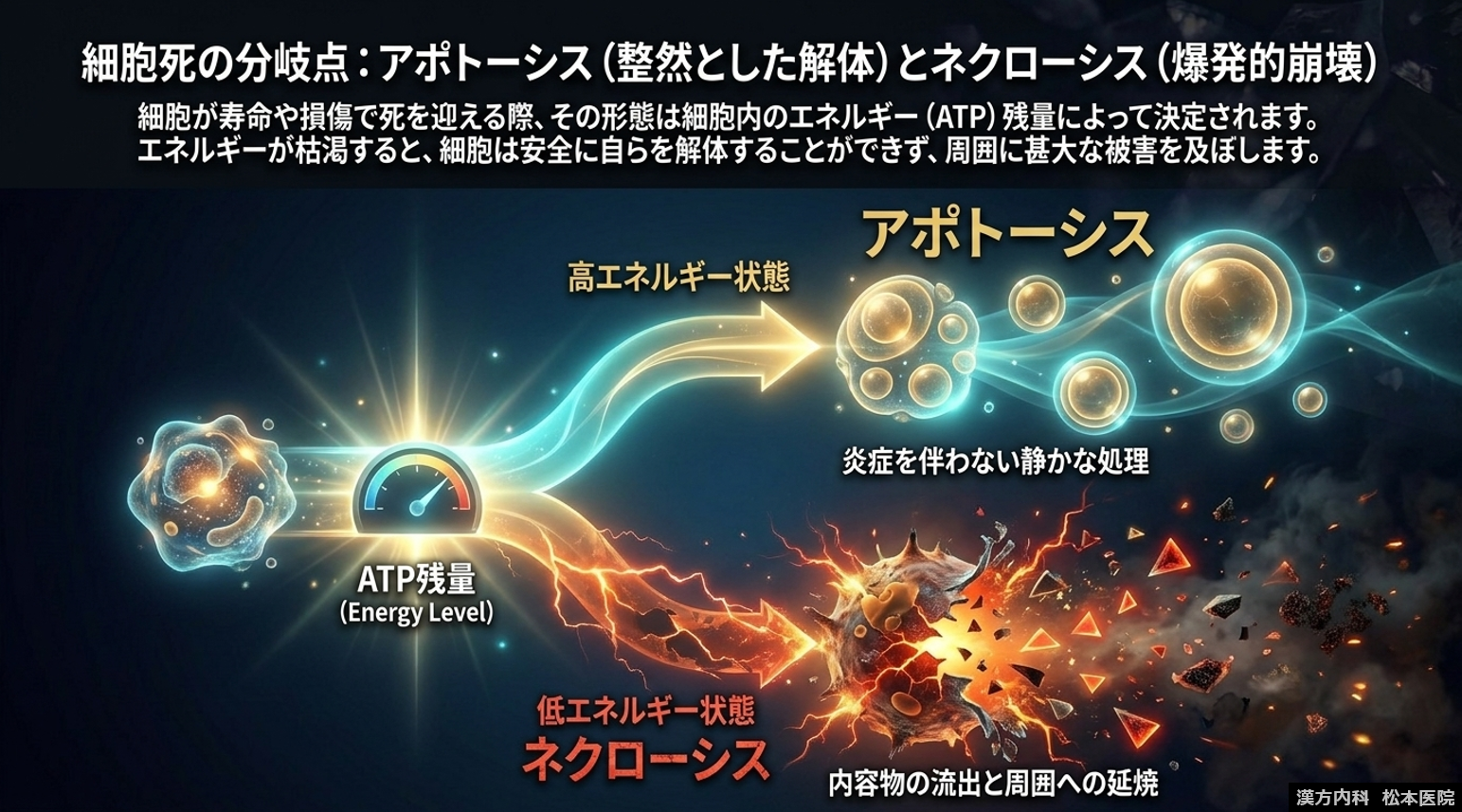
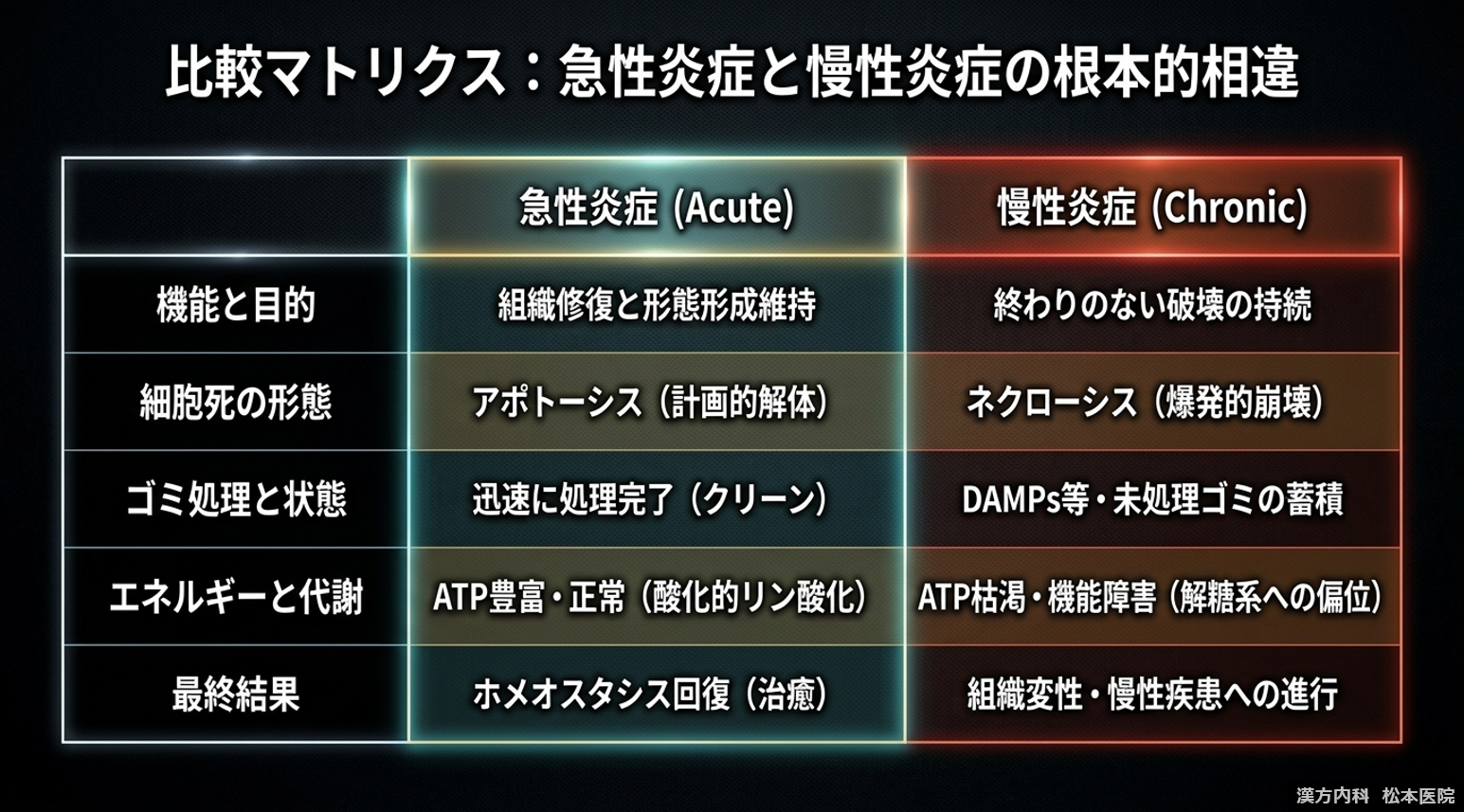
擦り傷・切り傷・刺し傷・火傷などの外傷、細菌感染などで急速に起こるのが「急性炎症」です。典型的には、血流の増加や血管から組織への水分の移動によって、炎症の四主徴である赤み・熱感・腫れ・痛みなどが現れます。初期には好中球を中心とした免疫細胞が炎症部位に集まり、マクロファージなどと協力して微生物や傷んだ組織などのゴミを処理します[331]。このゴミ処理・ゴミ掃除が無事に終わっていけば、多くの場合、比較的短期間で収束へ向かいます。この収束には、免疫による積極的な働きが関わっています。役割を終えた好中球がアポトーシスという仕組みで死んでいくと、マクロファージがそれを回収(ゴミ掃除)します[336]。この「死細胞や細胞断片の片付け」は、炎症を促す物質の産生を抑える働きにもつながります[337,338]。免疫は、炎症を起こすとともに、それを終わらせるプロセスにも関与しているということです。少量の異物や日常的に生じる死細胞は、目立った炎症を起こさずに処理されることもあります[339]。また、感染しても無症状で経過する場合があります。ただし、局所では症状が出ない程度の小さな炎症反応が起きている可能性があります[340]。
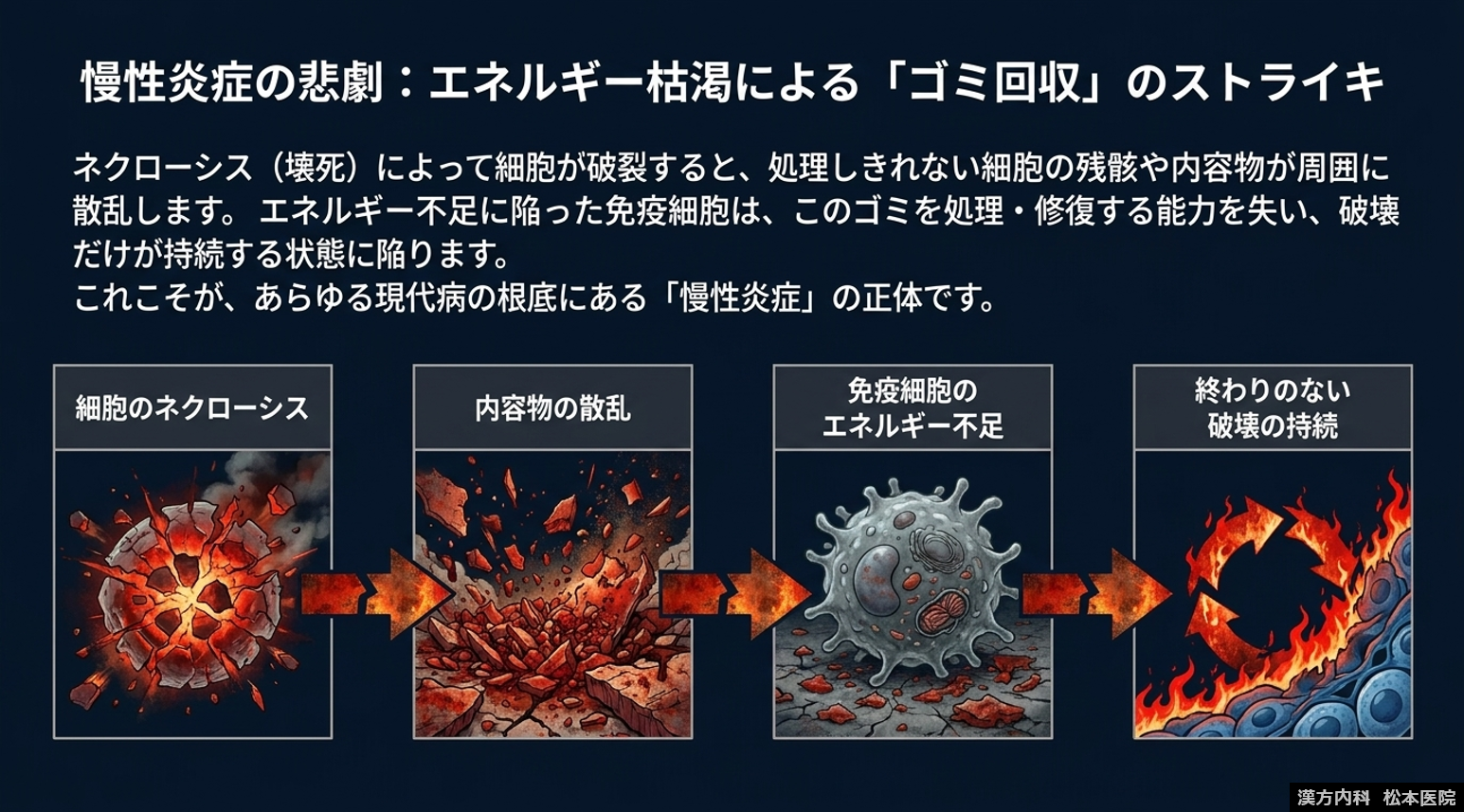
一方、炎症を起こす刺激が残り続けたり、死細胞の処理や炎症を収束させる仕組みが十分に働かなかったりすると、免疫応答が長引き、炎症が慢性化していきます[341,342]。このように、本来治癒へのプロセスである炎症が持続し、組織障害などを引き起こす破壊のプロセスへと舵を切り始めるようになっていきます。これがまさに「慢性炎症」です。慢性炎症は急性炎症から移行する場合もあれば、明らかな急性期を経ず、弱い炎症が徐々に続く場合もあります[331]。慢性炎症では、マクロファージやリンパ球などが持続的に関与し、組織の損傷と修復が並行して起こります[343]。炎症が新たな細胞傷害を生み、その傷害がさらに免疫細胞を刺激するという悪循環も生じます[341]。長期化すると、組織が硬くなる線維化や、臓器の機能低下につながることがあります[344]。局所にとどまる場合もあり、強い痛みや発熱を伴わずに進行することもあります[345]。
その背景には、次のような要因が関わります。
・持続する感染や慢性的な組織傷害:微生物・細胞やその残骸、化学物質などの持続的暴露[331]
・免疫応答調節異常:自己免疫やアレルギーなど、特定の物質に対する反応の持続[346]
・慢性的なストレスや睡眠不足:神経・ホルモン系を介した免疫調節の乱れ[347-349]
・腸内環境の乱れ:腸内細菌叢の変化や腸管バリア機能の低下[350,351]
・肥満などに伴う代謝異常:脂肪組織への免疫細胞の集積や炎症性物質の産生[352]
・老化細胞の蓄積:老化細胞が放出する炎症性物質による周囲への影響[353]
慢性炎症では、異物や死細胞を処理する働きが低下する一方で、炎症を促す反応は過剰に続くなど、免疫の働きに偏りが生じることがあります[329,337]。ストレスについても、免疫低下による感染防御の低下に加え、むしろ炎症を抑える調節が乱れ、炎症が遷延化・慢性化する仕組みが示されています。これは、「ゴミ処理」という比喩でいえば、処理すべき対象が増え続けたり、ゴミ処理と組織修復の連携が崩れたりしている状態です[280,328,354]。
慢性炎症は、動脈硬化など、実際に多くの病気の発症・進行に関わることから注目されています[355,356]。身体の健康には、必要な炎症を起こす力とともに、それを適切に収束させ、組織の機能と恒常性を回復する力が欠かせないのです。
参考文献▽
[331] R. Medzhitov, Origin and physiological roles of inflammation, Nature 454 (2008) 428–435. 10.1038/nature07201.
[332] K. Hoshino, O. Takeuchi, T. Kawai, H. Sanjo, T. Ogawa, Y. Takeda, K. Takeda, S. Akira, Cutting edge: Toll-like receptor 4 (TLR4)-deficient mice are hyporesponsive to lipopolysaccharide: evidence for TLR4 as the Lps gene product, J Immunol 162 (1999) 3749–3752.
[333] P. Scaffidi, T. Misteli, M.E. Bianchi, Release of chromatin protein HMGB1 by necrotic cells triggers inflammation, Nature 418 (2002) 191–195. 10.1038/nature00858.
[334] M.P. Bevilacqua, J.S. Pober, M.E. Wheeler, R.S. Cotran, M.A. Gimbrone, Jr., Interleukin 1 acts on cultured human vascular endothelium to increase the adhesion of polymorphonuclear leukocytes, monocytes, and related leukocyte cell lines, The Journal of Clinical Investigation 76 (1985) 2003–2011. 10.1172/JCI112200.
[335] T. Lucas, A. Waisman, R. Ranjan, J. Roes, T. Krieg, W. Müller, A. Roers, S.A. Eming, Differential Roles of Macrophages in Diverse Phases of Skin Repair, The Journal of Immunology 184 (2010) 3964–3977. 10.4049/jimmunol.0903356.
[336] J.S. Savill, A.H. Wyllie, J.E. Henson, M.J. Walport, P.M. Henson, C. Haslett, Macrophage phagocytosis of aging neutrophils in inflammation. Programmed cell death in the neutrophil leads to its recognition by macrophages, The Journal of Clinical Investigation 83 (1989) 865–875. 10.1172/JCI113970.
[337] V.A. Fadok, D.L. Bratton, A. Konowal, P.W. Freed, J.Y. Westcott, P.M. Henson, Macrophages that have ingested apoptotic cells in vitro inhibit proinflammatory cytokine production through autocrine/paracrine mechanisms involving TGF-beta, PGE2, and PAF, The Journal of Clinical Investigation 101 (1998) 890–898. 10.1172/JCI1112.
[338] M.-L.N. Huynh, V.A. Fadok, P.M. Henson, Phosphatidylserine-dependent ingestion of apoptotic cells promotes TGF-β1 secretion and the resolution of inflammation, The Journal of Clinical Investigation 109 (2002) 41–50. 10.1172/JCI11638.
[339] A.G. N, S.J. Bensinger, C. Hong, S. Beceiro, M.N. Bradley, N. Zelcer, J. Deniz, C. Ramirez, M. Díaz, G. Gallardo, C.R. de Galarreta, J. Salazar, F. Lopez, P. Edwards, J. Parks, M. Andujar, P. Tontonoz, A. Castrillo, Apoptotic cells promote their own clearance and immune tolerance through activation of the nuclear receptor LXR, Immunity 31 (2009) 245–258. 10.1016/j.immuni.2009.06.018.
[340] Y. Huang, A.K. Zaas, A. Rao, N. Dobigeon, P.J. Woolf, T. Veldman, N.C. Øien, M.T. McClain, J.B. Varkey, B. Nicholson, L. Carin, S. Kingsmore, C.W. Woods, G.S. Ginsburg, A.O. Hero, III, Temporal Dynamics of Host Molecular Responses Differentiate Symptomatic and Asymptomatic Influenza A Infection, PLOS Genetics 7 (2011) e1002234. 10.1371/journal.pgen.1002234.
[341] C. Nathan, A. Ding, Nonresolving inflammation, Cell 140 (2010) 871–882. 10.1016/j.cell.2010.02.029.
[342] H. Ait-Oufella, V. Pouresmail, T. Simon, O. Blanc-Brude, K. Kinugawa, R. Merval, G. Offenstadt, G. Lesèche, P.L. Cohen, A. Tedgui, Z. Mallat, Defective mer receptor tyrosine kinase signaling in bone marrow cells promotes apoptotic cell accumulation and accelerates atherosclerosis, Arterioscler Thromb Vasc Biol 28 (2008) 1429–1431. 10.1161/atvbaha.108.169078.
[343] J.S. Duffield, S.J. Forbes, C.M. Constandinou, S. Clay, M. Partolina, S. Vuthoori, S. Wu, R. Lang, J.P. Iredale, Selective depletion of macrophages reveals distinct, opposing roles during liver injury and repair, The Journal of Clinical Investigation 115 (2005) 56–65. 10.1172/JCI22675.
[344] T.A. Wynn, T.R. Ramalingam, Mechanisms of fibrosis: therapeutic translation for fibrotic disease, Nature Medicine 18 (2012) 1028–1040. 10.1038/nm.2807.
[345] A.K. Brown, P.G. Conaghan, Z. Karim, M.A. Quinn, K. Ikeda, C.G. Peterfy, E. Hensor, R.J. Wakefield, P.J. O'Connor, P. Emery, An explanation for the apparent dissociation between clinical remission and continued structural deterioration in rheumatoid arthritis, Arthritis & Rheumatism 58 (2008) 2958–2967. https://doi.org/10.1002/art.23945.
[346] S.J. Galli, M. Tsai, A.M. Piliponsky, The development of allergic inflammation, Nature 454 (2008) 445–454. 10.1038/nature07204.
[347] S. Cohen, D. Janicki-Deverts, W.J. Doyle, G.E. Miller, E. Frank, B.S. Rabin, R.B. Turner, Chronic stress, glucocorticoid receptor resistance, inflammation, and disease risk, Proc Natl Acad Sci U S A 109 (2012) 5995–5999. 10.1073/pnas.1118355109.
[348] C.S. McAlpine, M.G. Kiss, F.M. Zuraikat, D. Cheek, G. Schiroli, H. Amatullah, P. Huynh, M.Z. Bhatti, L.P. Wong, A.G. Yates, W.C. Poller, J.E. Mindur, C.T. Chan, H. Janssen, J. Downey, S. Singh, R.I. Sadreyev, M. Nahrendorf, K.L. Jeffrey, D.T. Scadden, K. Naxerova, M.P. St-Onge, F.K. Swirski, Sleep exerts lasting effects on hematopoietic stem cell function and diversity, J Exp Med 219 (2022). 10.1084/jem.20220081.
[349] C.S. McAlpine, M.G. Kiss, S. Rattik, S. He, A. Vassalli, C. Valet, A. Anzai, C.T. Chan, J.E. Mindur, F. Kahles, W.C. Poller, V. Frodermann, A.M. Fenn, A.F. Gregory, L. Halle, Y. Iwamoto, F.F. Hoyer, C.J. Binder, P. Libby, M. Tafti, T.E. Scammell, M. Nahrendorf, F.K. Swirski, Sleep modulates haematopoiesis and protects against atherosclerosis, Nature 566 (2019) 383–387. 10.1038/s41586-019-0948-2.
[350] M. Schaubeck, T. Clavel, J. Calasan, I. Lagkouvardos, S.B. Haange, N. Jehmlich, M. Basic, A. Dupont, M. Hornef, M. von Bergen, A. Bleich, D. Haller, Dysbiotic gut microbiota causes transmissible Crohn's disease-like ileitis independent of failure in antimicrobial defence, Gut 65 (2016) 225–237. 10.1136/gutjnl-2015-309333.
[351] L. Su, L. Shen, D.R. Clayburgh, S.C. Nalle, E.A. Sullivan, J.B. Meddings, C. Abraham, J.R. Turner, Targeted epithelial tight junction dysfunction causes immune activation and contributes to development of experimental colitis, Gastroenterology 136 (2009) 551–563. 10.1053/j.gastro.2008.10.081.
[352] S.P. Weisberg, D. McCann, M. Desai, M. Rosenbaum, R.L. Leibel, A.W. Ferrante, Jr., Obesity is associated with macrophage accumulation in adipose tissue, The Journal of Clinical Investigation 112 (2003) 1796–1808. 10.1172/JCI19246.
[353] J.-P. Coppé, C.K. Patil, F. Rodier, Y. Sun, D.P. Muñoz, J. Goldstein, P.S. Nelson, P.-Y. Desprez, J. Campisi, Senescence-Associated Secretory Phenotypes Reveal Cell-Nonautonomous Functions of Oncogenic RAS and the p53 Tumor Suppressor, PLOS Biology 6 (2008) e301. 10.1371/journal.pbio.0060301.
[354] S. Cohen, D. Janicki-Deverts, W.J. Doyle, G.E. Miller, E. Frank, B.S. Rabin, R.B. Turner, Chronic stress, glucocorticoid receptor resistance, inflammation, and disease risk, Proceedings of the National Academy of Sciences 109 (2012) 5995–5999. doi:10.1073/pnas.1118355109.
[355] P.M. Ridker, B.M. Everett, T. Thuren, J.G. MacFadyen, W.H. Chang, C. Ballantyne, F. Fonseca, J. Nicolau, W. Koenig, S.D. Anker, J.J.P. Kastelein, J.H. Cornel, P. Pais, D. Pella, J. Genest, R. Cifkova, A. Lorenzatti, T. Forster, Z. Kobalava, L. Vida-Simiti, M. Flather, H. Shimokawa, H. Ogawa, M. Dellborg, P.R.F. Rossi, R.P.T. Troquay, P. Libby, R.J. Glynn, Antiinflammatory Therapy with Canakinumab for Atherosclerotic Disease, N Engl J Med 377 (2017) 1119–1131. 10.1056/NEJMoa1707914.
[356] P.M. Ridker, B.M. Everett, T. Thuren, J.G. MacFadyen, W.H. Chang, C. Ballantyne, F. Fonseca, J. Nicolau, W. Koenig, S.D. Anker, J.J.P. Kastelein, J.H. Cornel, P. Pais, D. Pella, J. Genest, R. Cifkova, A. Lorenzatti, T. Forster, Z. Kobalava, L. Vida-Simiti, M. Flather, H. Shimokawa, H. Ogawa, M. Dellborg, P.R.F. Rossi, R.P.T. Troquay, P. Libby, R.J. Glynn, Antiinflammatory Therapy with Canakinumab for Atherosclerotic Disease, New England Journal of Medicine 377 (2017) 1119–1131. doi:10.1056/NEJMoa1707914.
まだコメントはありません。